Tutorials
In the evolving landscape of software development, artificial intelligence is reshaping traditional tools. This piece explores Cursor AI, an innovative code editor specifically engineered to leverage AI, offering a glimpse into its practical applications for developers. While acknowledging the initial fervor surrounding Large Language Models (LLMs) has somewhat subsided, the focus here is on assessing the tangible benefits and potential challenges this AI-first editor presents.
Cursor AI positions itself as a robust solution for accelerating development workflows, featuring functionalities that enable coding through natural language, identifying and rectifying runtime errors, and efficiently locating specific code segments. Its architecture, derived from VSCode, integrates language extensions to support a wide array of codebases, although it distinguishes itself from a full-fledged Integrated Development Environment (IDE). A notable aspect of Cursor AI is its dependency on OpenAI's services, which introduces a tiered pricing model based on 'slow' and 'fast' GPT-4 and GPT-3.5 calls. This dependency, while technically manageable, ties Cursor AI's developmental trajectory to OpenAI's evolving offerings.
The author's hands-on experience with Cursor AI began with a Rust file containing an intentional bug, serving as a test case for its debugging prowess. Initially, the editor successfully identified a missing crate, a fundamental component of Rust projects. However, the more significant challenge lay in detecting a subtle logical flaw within the code: a hangman-style game where a single correct character guess would erroneously trigger a win condition. Cursor AI's subsequent analysis accurately pinpointed this design flaw, providing a clear and comprehensive explanation of the problem. This capability highlights its potential to assist developers, particularly those less familiar with a specific codebase or programming paradigm, by offering insights that might otherwise require extensive manual debugging or unit testing.
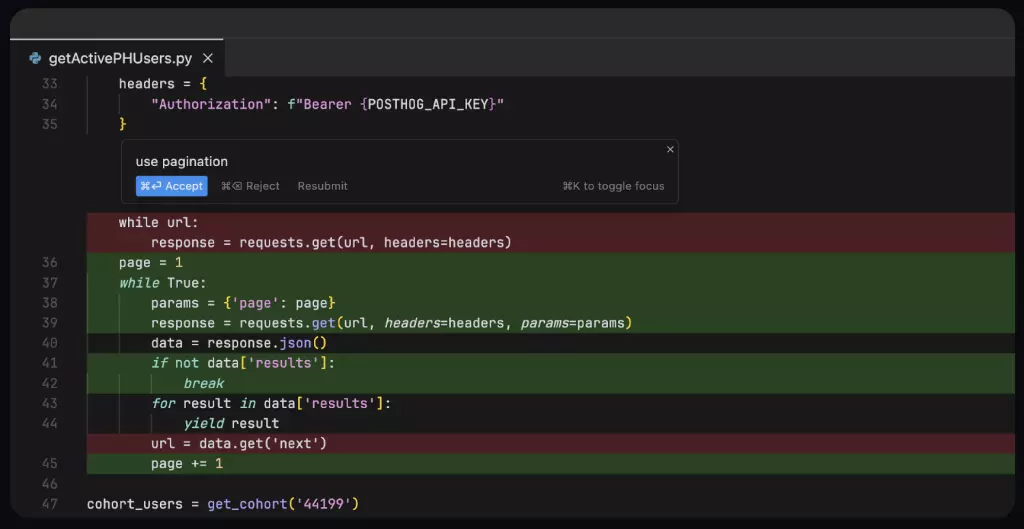
Beyond basic bug identification, Cursor AI demonstrated its utility in more complex scenarios. When asked to modify a C code snippet related to a linked list, using a simple "Cmd+K" prompt, the editor generated sensible suggestions to prevent common errors like null pointer dereferences. It presented these modifications using a visual diff interface, similar to merge tools, making the proposed changes easy to review. Furthermore, the "with codebase" feature proved effective in providing detailed explanations of existing code structures, such as a double-linked list, by merely inputting a variable name. This functionality serves as a valuable learning aid for intermediate developers confronting new code, bridging knowledge gaps more efficiently than traditional documentation or forums like Stack Overflow. Another notable feature allows users to query specific libraries or functions within the code using an '@' command in the chat window, offering contextual explanations of their usage and purpose.
A particularly strong feature of Cursor AI is its code translation capability. The author successfully translated a Python function, designed to generate pseudorandom numbers based on system time and process ID, into Rust. The generated Rust code not only accurately replicated the Python function's logic but also included an amusing, albeit practically harmless, edge case related to time measurement before the Unix epoch. This demonstrates Cursor AI's ability to facilitate cross-language development, a task often time-consuming and prone to errors when performed manually. This capability could significantly benefit development teams working with polyglot systems or during migrations between programming languages.
While recognizing its strengths, the author also points out areas for improvement and broader implications. The current user interface for AI interactions, particularly the integration of chat windows within the editor and the presentation of explanation text directly in the code pane, feels somewhat nascent and could benefit from refinement. The editor's interaction with standard undo functionalities also presented occasional difficulties. Despite these minor issues, the emergence of tools like Cursor AI signals a significant shift in the software development paradigm. It suggests a future where code manipulation and understanding become more accessible to a wider range of engineers, potentially lowering the entry barrier for complex development tasks. This evolution might lead to a new generation of developers who, armed with AI-powered assistants, can achieve high levels of productivity without needing the deep, intuitive understanding traditionally associated with master craftsmen in the field.